Why Doing “Nothing” is Sometimes the Smartest Move

It is human nature to follow the crowd. If you saw everyone jumping off a cruise ship for fear that it was sinking, you might assume that the best course of action is to jump overboard yourself. The problem with that kind of rash decision-making is that if you’re wrong, the ship is moving along without you. I want you to think back to April of 2025 for a moment. The unknowns surrounding the new tariff policy were striking fear into the eyes of investors. What was dubbed “Liberation Day,” which included a blanket 10% tariff on most goods, triggered a sudden, drastic market sell-off that lasted for most of the month. During this time of uncertainty, many were tempted to cut their losses and get out of the market, which is an understandably uncomfortable feeling. Some sold their positions, and unless they quickly re-entered, they missed out on the subsequent growth. It bears acknowledging that hindsight is 20/20, but that does not discount the reality that sometimes, the smartest move is not making one at all.
Why Volatility Triggers Happy Feet (and Bad Decisions)
Our innate ability to perceive and avoid imminent danger serves us well, as humans. We’re wired to avoid loss and uncertainty, a trait often taken hostage by our 24-hour news cycle. Media coverage of economic and geopolitical events subjects us to a constant barrage of information that can sometimes spur us into an unnecessary state of frenzy. Part of a financial advisor's job is to help clients distinguish between feeling like something is wrong and something actually being wrong. A common quip among advisors is that we aim to “take the emotion out of investing.” When you see your account balance drop 10% in a matter of days, you are right to be concerned. Asking the right questions is always a good place to start, but it doesn’t always mean you need to turn that asking into action. Anxiety (especially around investing) is normal – but acting on that anxiety can be costly.
What “Doing Nothing” Actually Means
You may have heard the term “paralysis by analysis.” There is a misconception that inaction is equivalent to irresponsibility. If you sit on your hands long enough, that can be an issue, but taking the time to contemplate and gather information is anything but immature. The reality for many investors is that investing is for long-term goals. If you work with a financial advisor and are saving for retirement, you are likely following a plan that has been years in the making. You have to keep the proper, long-term perspective in mind when market events attempt to steal your attention.
“Doing nothing” in this context means staying the course. If you’re still working and accumulating retirement assets, your strategy likely involves saving monthly into retirement accounts through recurring contributions (dollar-cost averaging). You are likely investing broadly across the stock market, allowing diversification to do its job. Another phrase you hear advisors say is “time in the market beats timing the market,” and this is the essence of “doing nothing” in market downturns. Stay committed, knowing that selling positions at a loss often does more harm than good.
When Doing Nothing is Usually the Right Choice
April of 2025 is the perfect example, and I’ll call your attention back to that again. While the volatility of “Liberation Day” was scary, it likely didn’t have any actual bearing on your situation unless you realized those short-term losses by clicking “sell.” Yes, inflation was high, and the threat of tariffs only promised to make matters worse at the check-out. In reality, a market sell-off is the perfect time to keep your head down and continue making your regular contributions.
Another way to say this is: If your personal circumstances haven't changed, don’t deviate from the plan. If you’ve lost a job or had a major unexpected expense, then you can take some time to recalibrate – otherwise, do nothing.
Here are some examples of times when you should “Do Nothing”:
Short-Term Market Drops
Election Years and Political Noise
Temporary underperformance of certain parts of the portfolio
Periods of high inflation
This is not an exhaustive list, and the reality is that good financial planning accounts for more gray areas than we can cover here. If tax-law changes or time horizons are making you question your strategy, you should absolutely reach out to a financial advisor to help you make sense of how these variables can impact your situation.
Hidden Cost of Changes
As previously mentioned, there are drawbacks to constant change in the world of investing. Like any area of life, if you’re always changing things, you are likely spending more than necessary (think kitchen renovations, wardrobe overhauls, or always needing the newest smartphone).
When you hop in and out of the market, you run the risk of missing the market’s best days. Studies have shown that missing the top 10 market days in a year can cut returns in half.
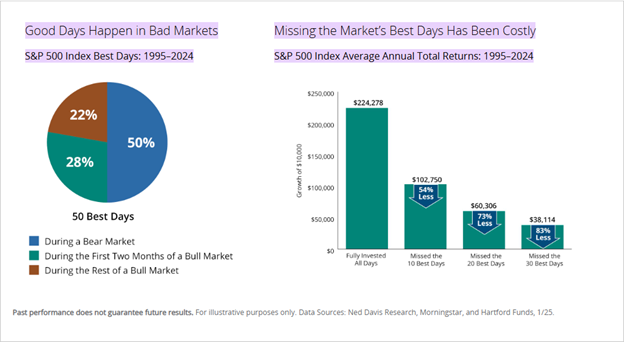
Source: Hartford Funds, "Timing the Market Is Impossible," Managing Volatility series, January 2025. Data: Ned Davis Research, Morningstar, and Hartford Funds. Past performance does not guarantee future results. For illustrative purposes only.
If you invest at all in a taxable account, there can be increased taxes from short-term moves in and out of positions, triggering short-term capital gains, which is not as favorable as the long-term rate you might otherwise get with a more disciplined approach. Some investors use funds with associated trading fees, meaning excess transactions tied to market timing can further cut into returns.
There are non-monetary risks that come with a desire for constant change as well. Emotional fatigue and a general loss of confidence can weaken an investor’s resolve and discourage them from continuing. What may seem like a good idea may ultimately cost you. As Morgan Housel states in The Psychology of Money, “History is littered with good ideas taken too far, which are indistinguishable from bad ideas.”
The Advisor’s Role
It is important to know when to act and when not to act. A financial advisor can be the sounding board you need to make the right decision. The role of the advisor is really to act as a filter rather than a forecaster. Money can be emotional, so when you see your account balance going in the wrong direction, you need a level head to keep the bigger picture in mind. Advisors help clients stay aligned with their goals and objectives during emotional times. A good financial plan eliminates the need for guesswork because it is designed to be a template used for assessing such times. The structure of a plan and the accountability of an advisor who has your long-term well-being in mind are critical to have in place when those bear markets arrive.
Ultimately, it is about having a relationship you can trust, more than a product that shines. If you’re feeling uneasy, stop, zoom out, and take some time to review your goals or schedule a meeting with one of our financial advisors who can help you develop a plan that is right for you. Remember - patience can be a strategy, and it just might be the one you lean on the most in difficult market environments.