The "milk in your coffee" problem: what the IRS pro rata rule means for your backdoor Roth
A common retirement strategy can backfire — here's what you need to know before you convert.
Avoid the Backdoor Roth Backfire
If you don’t understand the IRS’s pro rata rule, you could end up paying more in taxes than you save when making a backdoor Roth contribution. Taxpayers can use a simple formula to understand how much of their contribution is tax-free, and what they can do to avoid diluting the tax advantage of making these contributions.
Do you take it black, or with cream?
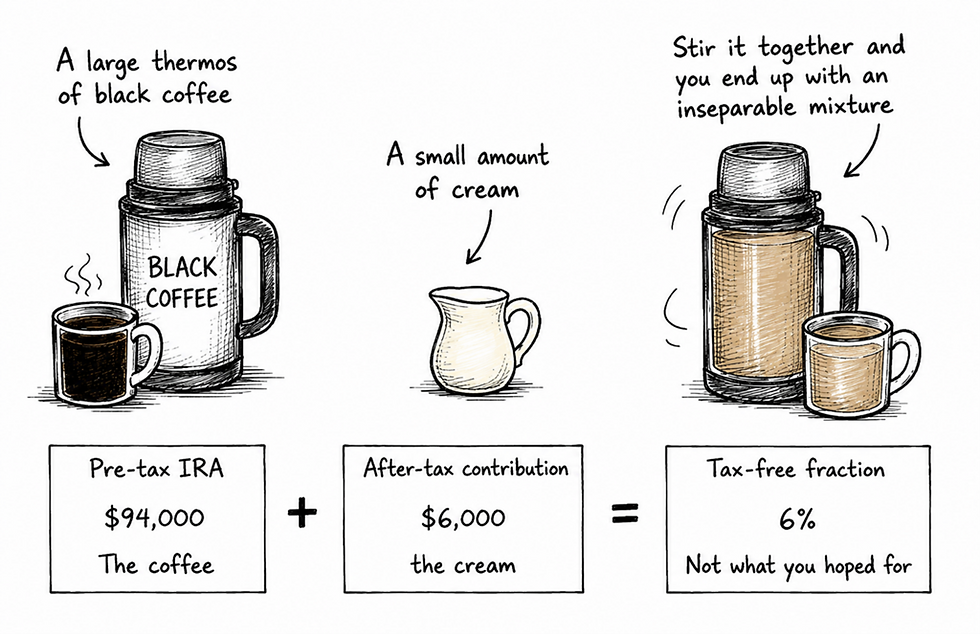
Imagine you have a giant thermos of black coffee — that's your pre-tax Traditional IRA. You want to add a splash of pure cream (your after-tax backdoor Roth contribution), planning to pour only the cream into a clean mug (your Roth IRA). There's just one problem: the moment cream touches coffee, it's all one mixture. You can't pour just the cream back out. Every pour will be a blend of both. The IRS pro rata rule works exactly the same way.
How the IRS sees your thermos
Under the pro rata rule, you cannot choose which "type" of money you're converting. Every dollar moved to a Roth IRA must reflect the ratio of pre-tax to after-tax money across all of your Traditional IRA, SEP IRA, and SIMPLE IRA balances. The formula is simple:
Tax-free fraction formula
[After-tax contributions ÷ Total IRA balance] = Tax-free fraction
A concrete example
Say you have $94,000 in a pre-tax Traditional IRA and you add a $6,000 after-tax backdoor contribution, for a total of $100,000. When you convert that $6,000 to Roth, only $360 is tax-free. The other $5,640 becomes taxable income. You wanted a cup of pure cream — instead you got a very coffee-flavored splash.
Why a large pre-tax IRA makes things worse
The larger your pre-tax IRA, the more diluted your cream becomes — and the higher your unexpected tax bill on conversion. At a large enough balance, the backdoor Roth becomes almost entirely taxable, defeating its purpose entirely.
The one workaround
Some people "empty the thermos" first — rolling their pre-tax IRA into a 401(k) if their plan allows it — leaving no coffee to dilute the cream. But if that option isn't available, the backdoor Roth strategy can cost more in taxes than it saves.
Ready to get this right?
Your retirement strategy deserves a second set of eyes. The pro rata rule catches many savers off guard, often at tax time. The advisors at Whitaker-Myers Wealth Managers can help you evaluate whether a backdoor Roth makes sense for your situation, and if so, how to structure it to minimize your tax exposure. Contact an advisor today.