For most Americans, the price of gasoline at the pump is one of the most direct ways the conflict in Iran touches their daily lives. Gasoline prices are prominently displayed and updated frequently, and filling up regularly is a basic necessity for commuting, running errands, and more. Diesel prices matter just as much, as they influence the transportation and manufacturing costs of goods throughout the economy. This is why these prices serve as key economic indicators, and why the ongoing situation in the Middle East has become a growing concern for both consumers and investors.
As the conflict extends into its second month, oil prices remain elevated with significant intraday swings, while headlines oscillate between proposed peace agreements and the possibility of further escalation. Brent crude is now (as of 3/28/26) trading above $110 per barrel and WTI above $100, meaning higher energy prices will weigh on household budgets, inflation metrics, and Federal Reserve policy decisions.
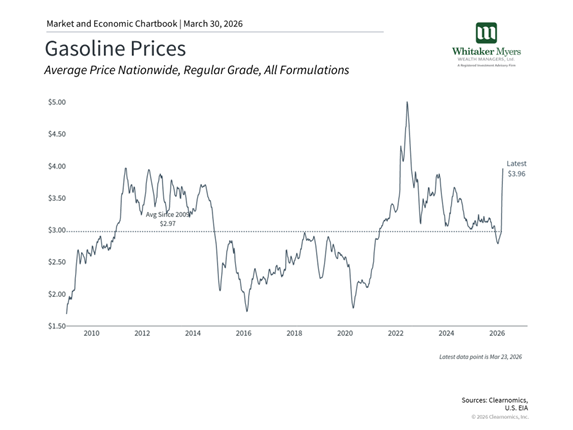
Gasoline prices have risen sharply
Fuel costs are putting direct pressure on household budgets
The national average for regular unleaded gasoline has climbed to around $4.00 per gallon, an increase of more than a dollar per gallon in just one month. While still below the record high of $5.00 per gallon reached in 2022, prices could worsen if oil remains elevated. For most households, filling up the car is a non-negotiable expense, meaning higher gasoline prices will directly reduce discretionary spending and savings. Even with the growing adoption of electric vehicles, most cars on the road today still run on gasoline, so rising pump prices affect nearly every household budget.
The impact on consumers is both direct and indirect. A simplified back-of-the-envelope calculation illustrates the effect on everyday spending. Assuming an average fill-up of 15 gallons, the current price increase adds $15 per visit to the gas station. For those who fill up once a week, that amounts to roughly $780 less per year. At the federal minimum wage of $7.25 per hour, that represents more than two additional hours of work. For the median American household, which earns just over $70,000 per year after taxes according to the latest Census Bureau statistics, this exceeds 1% of after-tax income meaningful, but likely manageable for most.

Gasoline prices reflect more than just crude oil costs
According to the U.S. Energy Information Agency, roughly half of the price at the pump reflects the cost of crude oil itself. The remaining half consists of refining costs, transportation and distribution, sales and marketing expenses, and federal and state taxes. This is partly why there is not a one-to-one relationship between oil prices and what consumers pay at the pump, and why prices in certain states differ considerably from the national average.
For investors, it is also worth noting that the oil futures curve is currently deeply "backwardated," meaning oil prices are much higher today than they are expected to be in the future. This signals that traders view the current spike as a temporary supply disruption rather than a permanent shift to higher prices. While this does not guarantee a quick resolution, it does suggest the market expects conditions to stabilize over time.

Higher energy prices complicate the inflation outlook
For investors, energy prices will directly impact headline inflation, as these costs are significant components of the Consumer Price Index. After several years of improving energy CPI readings, the recent jump in oil and gasoline prices will almost certainly push headline inflation higher in the coming months. Organizations such as the OECD now estimate that U.S. inflation could rise faster than expected this year.
Rising inflation also complicates the Federal Reserve’s decision-making. Markets have already shifted their expectations, with traders now assigning a greater probability to the Fed holding rates steady or even raising them rather than cutting. This reversal has introduced additional uncertainty for both equity and bond markets. That said, today’s situation differs meaningfully from the 1970s energy crisis—the U.S. is now the world’s largest oil and natural gas producer, and the Fed has significantly more credibility in anchoring inflation expectations. For investors, maintaining a well-constructed portfolio and staying focused on long-term financial goals remains the most prudent course of action.
What this all means to our investors?
Rising gasoline prices are a burden for consumers and will likely drive headline inflation higher. However, history shows that markets and the economy have navigated past energy shocks. Investors should maintain a long-term perspective, avoid overreacting to daily headlines, and stay focused on their financial plans. Connect with your advisor and make sure you’re aligned on your financial plan, risk tolerance, and current risk allocation.
What Rising Gasoline Prices Mean for Consumers and the Economy
April 13, 2026
Summit Puri
Whitaker-Myers Wealth Managers is an SEC-registered investment adviser firm. The information presented is for educational purposes only and intended for a broad audience. The information does not intend to make an offer or solicitation to sell or purchase any specific securities, investments, or investment strategies. Investments involve risk and are not guaranteed. Whitaker-Myers Wealth Managers reasonably believes that this marketing does not include any false or misleading statements or omissions of facts regarding services, investment, or client experience. Whitaker-Myers Wealth Managers has a reasonable belief that the content will not cause an untrue or misleading implication regarding the adviser’s services, investments, or client experiences. Please refer to the firm’s ADV Part 2A for material risks disclosures.
Past performance of specific investment advice should not be relied upon without knowledge of certain circumstances of market events, the nature and timing of the investments, and relevant constraints of the investment. Whitaker-Myers Wealth Managers has presented information in a fair and balanced manner.
Whitaker-Myers Wealth Managers is not giving tax, legal or accounting advice, consult a professional tax or legal representative if needed.
Copyright (c) 2023 Clearnomics, Inc. and Whitaker-Myers Wealth Managers, LTD. All rights reserved. The information contained herein has been obtained from sources believed to be reliable, but is not necessarily complete and its accuracy cannot be guaranteed. No representation or warranty, express or implied, is made as to the fairness, accuracy, completeness, or correctness of the information and opinions contained herein. The views and the other information provided are subject to change without notice. All reports posted on or via www.clearnomics.com or any affiliated websites, applications, or services are issued without regard to the specific investment objectives, financial situation, or particular needs of any specific recipient and are not to be construed as a solicitation or an offer to buy or sell any securities or related financial instruments. Past performance is not necessarily a guide to future results. Company fundamentals and earnings may be mentioned occasionally, but should not be construed as a recommendation to buy, sell, or hold the company's stock. Predictions, forecasts, and estimates for any and all markets should not be construed as recommendations to buy, sell, or hold any security--including mutual funds, futures contracts, and exchange traded funds, or any similar instruments. The text, images, and other materials contained or displayed in this report are proprietary to Clearnomics, Inc. and constitute valuable intellectual property. All unauthorized reproduction or other use of material from Clearnomics, Inc. shall be deemed willful infringement(s) of this copyright and other proprietary and intellectual property rights, including but not limited to, rights of privacy. Clearnomics, Inc. expressly reserves all rights in connection with its intellectual property, including without limitation the right to block the transfer of its products and services and/or to track usage thereof, through electronic tracking technology, and all other lawful means, now known or hereafter devised. Clearnomics, Inc. reserves the right, without further notice, to pursue to the fullest extent allowed by the law any and all criminal and civil remedies for the violation of its rights.


