Retirement Planning
Do You Know What You Own? Understanding the 3 Major Retirement Portfolio Types
Not all investment portfolios are built the same way. Associate Financial Advisor Joseph Browning breaks down the three major retirement portfolio types—indexed, factor-based, and actively managed—exploring their advantages, disadvantages, and approaches to investing. Learn why understanding what you own and how your portfolio works is an important step toward aligning your investments with your long-term financial goals.
Read More...

What Business Structure Is Best for Me? A Guide for Business Owners
Choosing a business structure is one of the most important decisions you’ll make when starting a business. Associate Financial Advisor Jonah Kearns breaks down the key differences between sole proprietorships, partnerships, LLCs, S Corporations, and C Corporations, including taxes, liability protection, ownership, and growth considerations.
Read More...

5 Retirement Mistakes to Avoid Before and During Retirement
Retirement planning involves much more than choosing investments and saving enough money. Financial Advisor David Gearhart highlights five common retirement mistakes—from waiting too long to plan and overlooking taxes to taking too much investment risk or making emotional decisions—and explains how thoughtful planning can help reduce financial stress.
Read More...

The Power of the Solo 401(k)
For self-employed individuals, a SEP IRA may be the first retirement plan that comes to mind—but it isn’t the only option. Nick Allen explains how a Solo 401(k) can offer higher contribution potential, Roth savings, and added flexibility for sole proprietors, LLC owners, S-corp owners, and 1099 workers.
Read More...

The "milk in your coffee" problem: what the IRS pro rata rule means for your backdoor Roth
Thinking about a backdoor Roth IRA contribution? The IRS pro rata rule could create an unexpected tax bill if you have pre-tax money in a Traditional, SEP, or SIMPLE IRA. Ben Allen breaks down how the rule works, why it matters, and what to consider before making a conversion.
Read More...

How Elevated Real Yields Shape Investment Decisions
Treasury yields have climbed to their highest levels in years, creating both opportunities and challenges for investors. In this edition of Investment Corner, Co-Chief Investment Officer & Chief Operating Officer Summit Puri explains what rising interest rates and real yields mean for stocks, bonds, inflation, and why maintaining a balanced portfolio is more important than ever.
Read More...

The "Perfect" Amount - Retiring Comfortably
Is there a magic number for retirement? Not exactly. In this article, Associate Financial Advisor Ethan Barry explains why a successful retirement is about more than reaching a savings milestone—it's about creating a personalized income strategy that aligns with your goals, lifestyle, and long-term financial needs.
Read More...

New for 2026: How Charitable Cash Contributions Can Help Lower Your Tax Bill
New tax rules for 2026 could create additional opportunities for taxpayers who make charitable cash contributions—even if they take the standard deduction. In this article, Financial Advisor Andrew Young explains how the updated deduction works, who qualifies, and how thoughtful charitable planning can maximize both your generosity and your tax savings.
Read More...

Why Doing “Nothing” is Sometimes the Smartest Move
Market volatility can make investors feel like they need to act—but sometimes the wisest decision is to stay the course. In this article, Financial Advisor Nick Allen explains why patience, discipline, and a long-term investment strategy can help investors avoid costly emotional decisions during uncertain markets.
Read More...

Mid-Year Outlook 2026: Key Investor Lessons for the Second Half of the Year
The first half of 2026 reminded investors that headlines don't always dictate market performance. Despite inflation, geopolitical tensions, and ongoing uncertainty, diversified portfolios continued to benefit from staying invested and focused on long-term goals.
Read More...
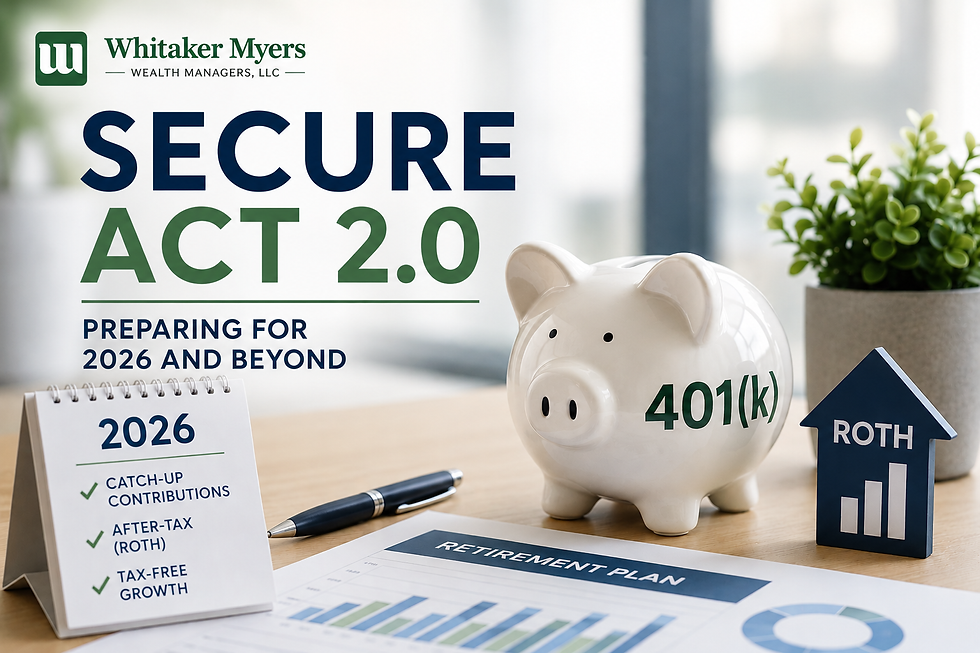
Understanding the SECURE Act 2.0
Beginning in 2026, higher-income employees will face new rules for 401(k) catch-up contributions under SECURE Act 2.0. In this article, Associate Financial Advisor Mica Dauch explains who is affected, why the change was made, and what it means for your retirement savings strategy.
Read More...
When Should You Claim Social Security? Key Factors to Consider Before Filing
Deciding when to claim Social Security is one of the most important retirement decisions you'll make. In this article, Associate Financial Advisor Mica Dauch explains the advantages of delaying benefits, important earnings limits to understand, special considerations for married couples, and how the breakeven age can help guide your claiming strategy.
Read More...
